Search Enterprise or @FordOnline
Please remove special characters

Ford at Le Mans, 60 Years Later: The Artifacts That Tell the Real Story of the 1966 Victory

Jun 10, 2026


Sixty years ago, Ford went to Le Mans and changed the company forever, but failure is part of this story.

In 1964 and 1965, Ford didn’t finish a single car at Le Mans. Not one. The company was a punchline in racing circles. 

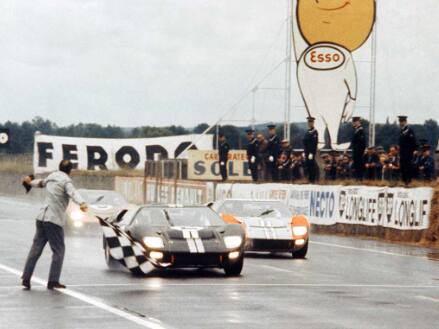
That all changed in 1966, Ford didn’t just win the 24 Hours of Le Mans, we swept the podium, finishing first, second, and third. That moment has been told and retold, but what’s rarely been seen is the evidence. The actual paper trail. The artifacts that show how it happened.

As we prepared to mark the 60th anniversary of Ford’s Le Mans victory, I went back into the archives to see what survived. What we found wasn’t mythology. It was receipts.

The first thing that stops people is the budget. The original 1966 Ford Le Mans budget — never publicly released — was $1.8 million. That budget documents spells out clearly the risk to Ford’s corporate reputation if the program didn’t succeed. That funding covered everything: cars, teams, logistics, racing operations. Adjusted for inflation, it’s roughly $18 million today. Even by modern motorsports standards, it’s lean. Seeing that number on original paper grounds the entire story. As with any adventurous project, we went over budget, and there was a memo begging for additional funds for more drivers, cars, and revised engines and chassis. The ultimate total? $3.5 million. Thank goodness it was approved.

Click to Enlarge

How were interviews conducted in the age before video conference calls? Telex! There’s also a multi‑page question‑and‑answer document from 1966. The questions were sent to Henry Ford II. His responses came back by telex. We have the original telex. You can see the cadence of his thinking — direct, unpolished, immediate. Those answers were published in Sports Illustrated the same week the 24 Hours of Le Mans was being run. History happening in real time. 

Then, there’s the celebration.

We have the original invitation to Ford’s Le Mans victory party at La Chanticleer in New York, a legendary racing restaurant of the era. But more telling than the invitation is what came after it — the bar tab. The wine. The champagne. The cocktails. And one cake. Just one. That detail matters. It paints a picture no press release ever could: tired people, relieved people, finally letting themselves enjoy the moment. We even have the cigar bill. Exact quantities. Exact cost. It’s funny now, but it’s also revealing. In 1966, this wasn’t a legend yet. It was still just a group of people who had pulled off something enormous.


One of the most meaningful documents is a complete list of everyone involved in the Ford Le Mans program. Engineers. Designers. Fabricators. Mechanics. Each received a special pair of cufflinks made for the race. We have the list of recipients. It’s a reminder that while names like Carroll Shelby are well known, the victory belonged to a much larger team that included Holman/Moody, Alan Mann racing, and a wide range of Ford Engineers. 

We also have the original press release issued after Ford’s win. It’s brief. Confident. Matter‑of‑fact. No victory laps. Just the result.

One artifact captures the spirit of the era better than anything else.

A solid‑gold cigarette lighter given to Henry Ford II by Lee Iacocca. A solid‑gold Mustang logo on the front. And engraved underneath: “To health, happiness, and 30% return.” That single line says more about Ford in the 1960s than any strategy deck ever could.


People often ask why these documents haven’t been shared before. The answer is simple: Ford didn’t show its work. Internal drafts stayed internal. Budgets stayed closed. That culture has only shifted in recent years.

And that’s why these artifacts matter now.


You can’t recreate this kind of history later. Twenty or 30 years from now, there won’t be bar tabs or telexes — just deleted emails and expired links. These physical documents show how Ford went from failure to dominance.

Victory tends to loosen purse strings. The 1967 Le Mans budget jumped to $3 million.

But 1966 was the pivot point.


Ford dominated Le Mans with a historic one-two-three finish. Ferrari didn’t finish. And you can feel that shift when you look at the documents themselves. 

Many of these artifacts will be on display at Le Mans this year as part of the 60th‑anniversary exhibition, organized around the teams, the drivers, and Ford itself, including the original 1966 distance trophy.

This anniversary isn’t about nostalgia. It’s about proof.

These artifacts don’t tell the legend of Ford at Le Mans. They show how it happened.


FTR: Ted Ryan is heritage brand manager and archivist at Ford.

RELATED MATERIALS